
Chapter 48 - The Snail Shell House part 1 - from my book Changes
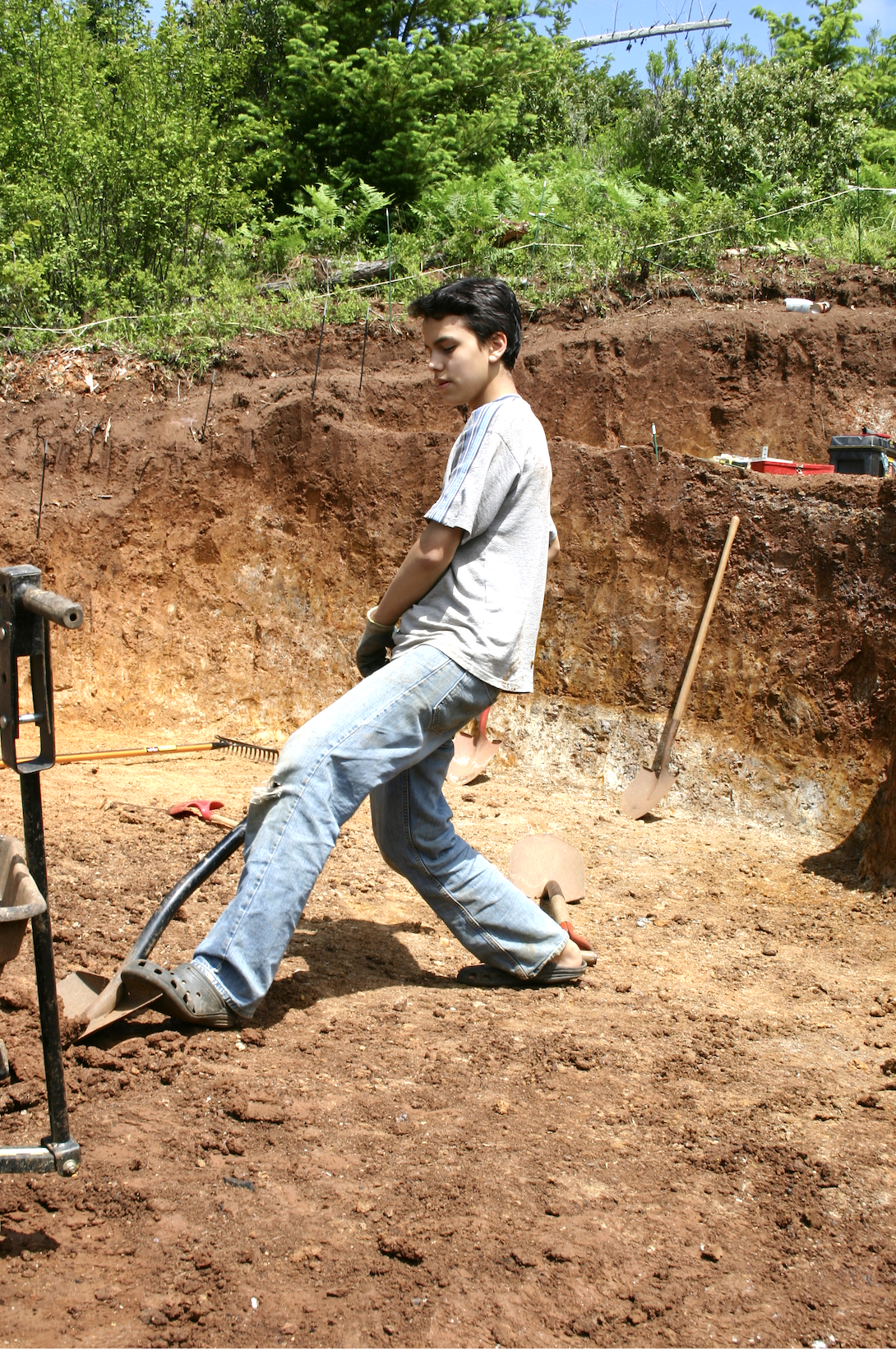
One of my sons, John Christopher, helping dig out the foot print of the snail shell house.
Chapter 48
The Snail Shell House - part 1
Once we were settled in and comfortable in the Wikki Tikki, it was time to start on the main house.
My sister Cheryl Leontina was still living there in the yurt we set up the year before, and she had started building a cob house in the shape of a spiral, like a nautilus shell. She talked about the strength of the spiral, and we compared her plan with the golden mean or Fibonacci sequence, which occurs over and over in nature, and also in art and architecture.
I decided to copy her idea and make my structure spiraled too. I called my house The Snail Shell House.
When I tell people I built a snail shell house in the woods, sometimes they think I built my house out of snail shells! Nooooo. It’s just a spiral like a snail shell.
The spot I had originally planned to build on was absolutely covered with wild irises. I decided I couldn’t disturb them so I moved my site over about 30 feet, which turned out to be a much better site anyway.
I spent about a day drawing out my new plans on a piece of notebook paper. To me, making a plan is as much fun as building. It’s like candy for my brain.
I decided I would make this snail shell house a split tri-level structure, dug into the side of the hill for maximum energy efficiency. The kitchen would be on the lowest level, the main floor would be about five feet higher, and the bedroom loft would be a couple feet higher, and above the kitchen. Overall, the structure would be about 600 square feet.
We rented a large backhoe to dig out the main shape of the house into the hillside. We spent a full day on that, adding the dirt we dug out of the hill to extend the level ground where the lowest level floor would be.
The following month was spent digging out the more detailed shape with hand shovels. My husband, my teenage sons, and I did the digging. The first few days I would tire out after only 10 minutes of digging and would have to rest awhile before I could continue. Gradually my stamina increased to where I could work for a half hour, then eventually I could work for 2 hours straight without a break. I was surprised and proud of myself for getting so much stronger.
The back wall of the dug out hill was full of shale and had moisture coming through. Looking back I wish I would have had the forethought to somehow tap into that water source and use it in the house. Instead, I simply put a curtain drain along that wall between the clay dirt and shale, and the wood wall inside. Along the wood wall, there is now a water proof barrier, along the clay/shale side is a water permeable membrane that would be a barrier between the clay / shale dirt wall and the round rock we poured in, bucket by bucket full, between the wood wall and moisture barrier, and the water permeable barrier and the clay / shale wall.
The wood wall along that back side was made by screwing 2 x 6 fir boards on the back side of the upright logs we set in place, in cemented post holes, every three feet along the spiral outline of the house. The board wall height was the same height as the ground behind it, leaving a couple feet of gap between the top of the boards and the roof rafters. The roof was held up by the upright logs outlining the spiral shape of the house.
To dig the post holes, my sister and I rented an auger. Not an auger held up by a little tractor, but a hand held heavy duty auger! In our learning curve using the auger, we scared ourselves when we let the auger go too deep in the clay ground before pulling it back up, and it got stuck. We panicked for a bit but finally got the huge drill back up out of the hole with the help of one of my teenage boys. Whew!
Cont …
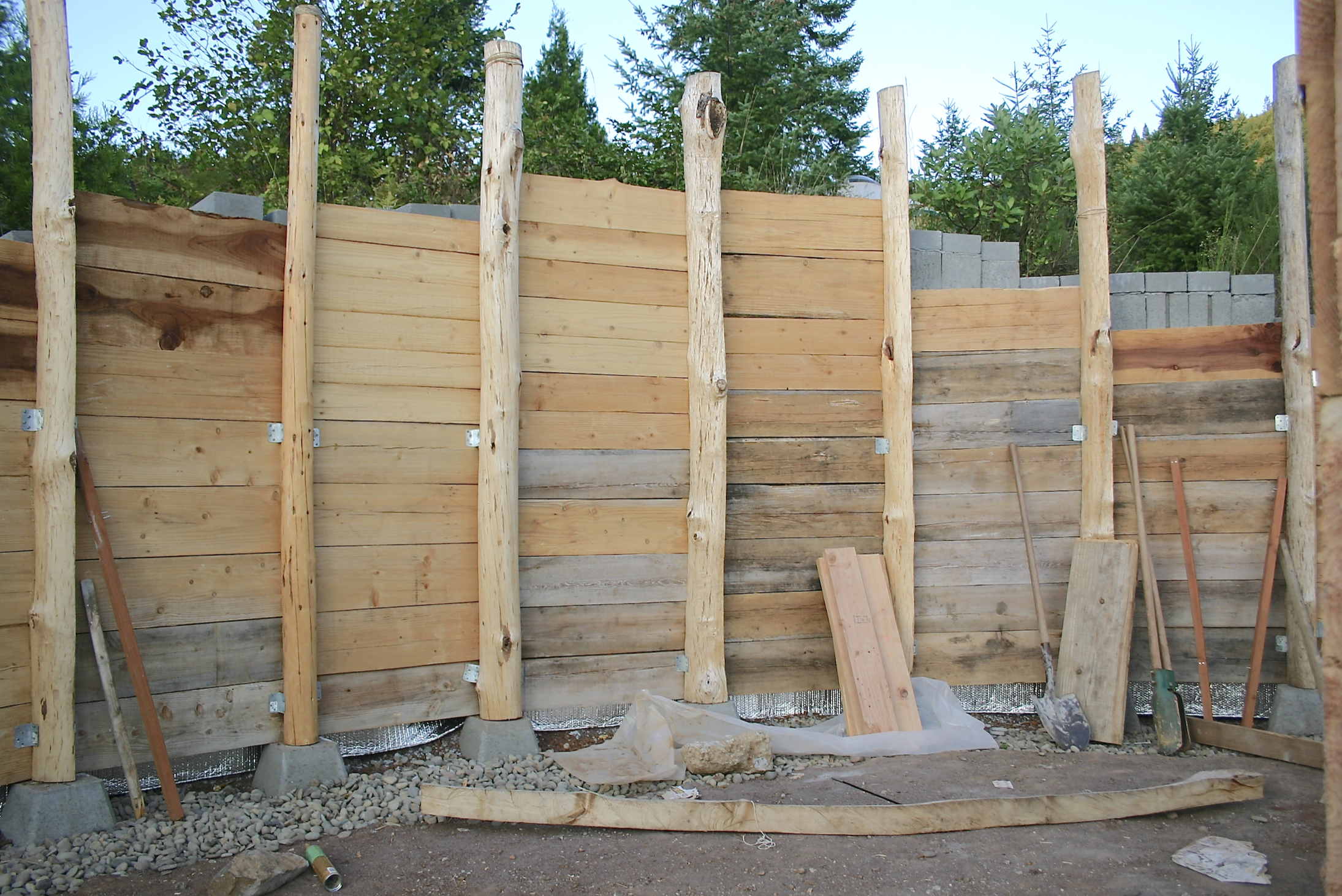
The back wall of the middle level.