
Chapter 62 Ancient Scout - from my book Changes
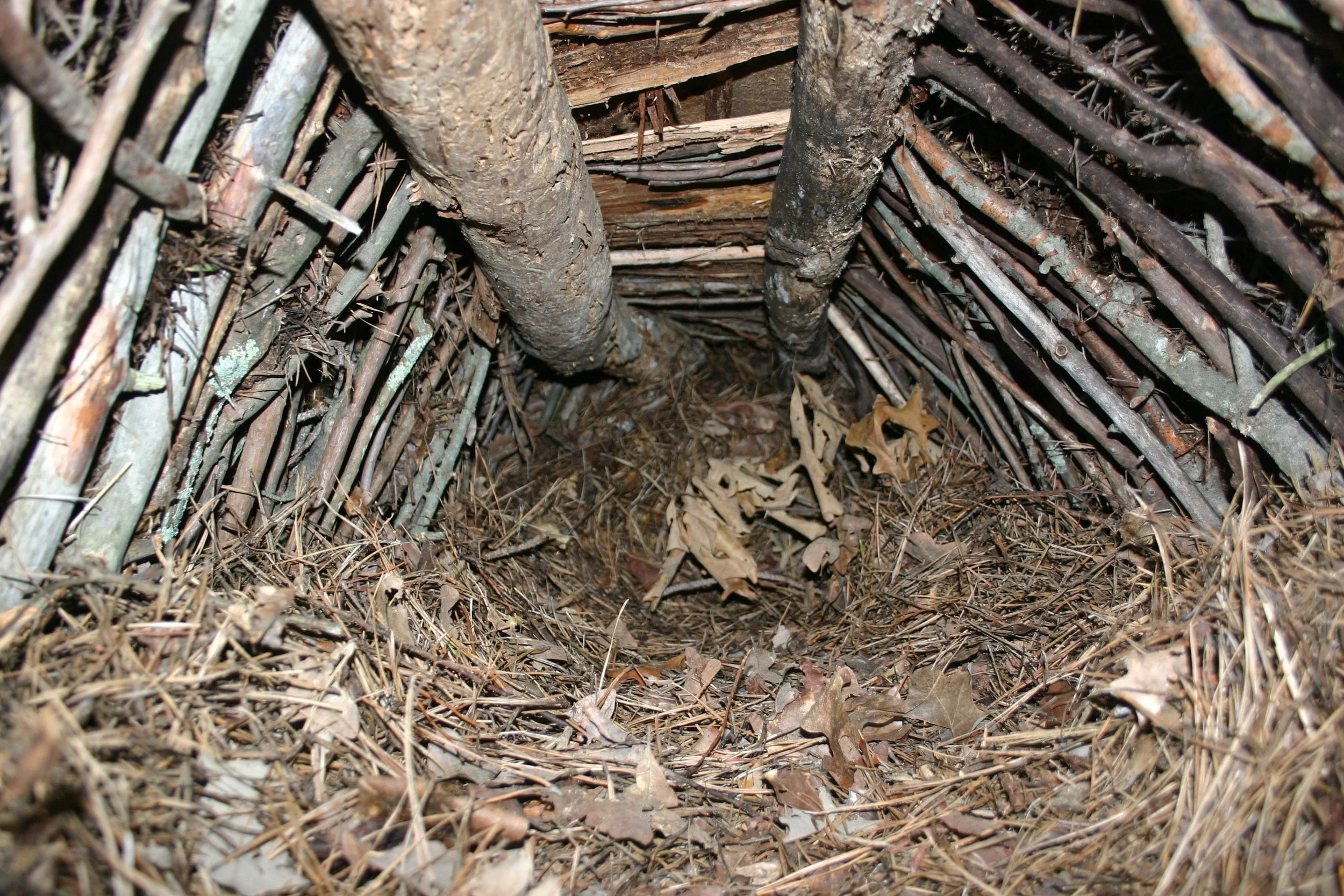
Inside my first debris hut at the Advanced Standard class.
Chapter 62
Ancient Scout
The week after Scout Class was the class called Ancient Scout. Ancient Scout class was mild in comparison to Scout Class, and really fun.
We spent a lot of time with our scout team around the campfire every evening, working on creating our team’s camp, and practicing some of the skills of the ancient scout. We worked on creating a space close to the trail where we would not be seen by people passing by. That meant camouflaging our camp area; creating a screen of interlaced branches above our tiny campfire that would disperse the smoke from the fire; and being hidden enough in the brush, off the trail, to not be found.
We were also supposed to use a different path each time we went into our camp. The scout must not be predictable; in other words, the scout must stay our of a rut.
Approaching our camp in a different way each time was honestly annoying, because we were moving through the brush without trails. I could see vividly how convenient a simple trail would be, and equally how much easier a rut is in life.
The group I was in was all young guys, along with me… old enough to be their mother. The guys were very accepting of me and I felt at home with them. We moved from place to place quickly since they were all young, and fortunately I was able to keep up with them after the previous week of rigorous exercise. In fact, by the time Ancient Scout class started, I had lost a bunch of weight. I had to do some necessary hand sewing to tighten up the waistline of my pants to keep them up.
One of the guys, Tor, tall and thin, with a feather in his dreads, was a great example to me in the way he conserved energy. As we moved along the trails to whatever destination we were aiming for, he was constantly gathering dead sticks and carrying them behind him as we moved along. By the time we got to our camp, he had already done some of the wood gathering.
Due to his example, later, when I made a heavy wool skirt out of a wool army blanket for the winter tracker classes, I added some hanging cords at the waist to tie sticks and things to. My thought was, ‘I can conserve energy by having a place to tie things while gathering as I walk along.’
Another one of the guys added color to the group with his stories and how he swore like a seasoned sailor. He reminded me of my Uncle Donald, whose language was peppered generously with G.D. this and G.D. that; J.C. this and J.C. that. There were no F bombs or other gutter talk, and none of it was said in anger. It kind of tickled me the way this kid talked like an old man from my youth. I wondered where he picked it up.
It was a privilege to be in that group. I got to be an observer of this group of 7 young men. And they were perfectly respectful towards me.
When it comes to survival, energy conservation is a big deal. Tom lectured about how, when he is in a survival situation, one of the first things he does is pick up a good throwing stick. If he sees some edible small game while moving through the landscape, he can try to harvest it with his throwing stick, thereby having dinner already caught.
Becoming effective with a throwing stick is quite a skill. When we practiced that skill in the Standard class, I thought it would be easy, but I found I was terrible at it. Mastering the throwing stick takes practice.
Another thing Tom does in a survival situation is make a travois to drag behind him. That way, he can gather firewood and other things he might want later, while he travels along looking for a campsite. He plans ahead like this to conserve energy, so he does not have to spend time and energy looking for those things later.
Once his camp site is found, the debris hut is next. The sacred order of survival is 1. Shelter, 2. Water, 3. Fire, and 4. Food. So the debris hut is created first. You can die more quickly from exposure than you can from lack of water or food, and a debris hut can keep you warm even in freezing temperatures if you make the walls thick enough. Above is a photo inside my first debris hut, built during the Advanced Standard class.
Once his shelter and water source are secured, and fire is sure, Tom would set up a trap line, using the primitive traps he learned from Grandfather Stalking Wolf. There are dead fall traps, like the figure 4 trap among others, and there are the many types of snares. Tom said that using traps and snares is a better way to conserve energy compared to walking around hunting.
As I attended Tom’s classes, I thirsted for knowledge. How would I find water? How would I carry water once I found it. How would I purify the water? Being in a situation without modern items would be a challenge. I have come to believe that containers and cordage are the unsung heroes of survival.
Another fear I had was: what would I do if a bear tears up my debris hut while I am in it? Or a wolf? Or maybe a poisonous snake comes in and snuggles up to me. All these concerns were gradually addressed as I attended class after class. As the years went by as a tracker student, I realized how much fear I had, and how that fear led me to crave these classes.
Identifying my fears about wilderness survival caused me to recognize, very consciously, how much fear I had in life, and how fear dictated my choices. Fear kept me stuck and afraid to make changes.
My ongoing struggle has been, and still is, overcoming fear.